
Coordinating Security Across Tenants, Landlords, and Management Companies

Updated: Jul 29

Commercial and retail property security often involves three parties with overlapping but distinct interests: the property owner/landlord, the management company running day-to-day operations, and individual tenants each with their own priorities. When these three don't have a clearly defined, coordinated security relationship, gaps open up in exactly the seams between their respective responsibilities.
Why misaligned responsibility creates real security gaps. A common failure pattern: the landlord assumes the management company has security fully covered, the management company assumes individual tenants handle their own storefront security, and individual tenants assume common-area security (which they don't control) covers anything beyond their own four walls. Each party's assumption is individually reasonable and collectively leaves gaps nobody is actually responsible for closing.
What a properly coordinated arrangement clarifies:
A written, specific division of responsibility — exactly which areas and functions fall under property-wide security (common areas, perimeter, overall emergency response) versus what remains each tenant's own responsibility (in-store loss prevention, individual storefront security).
A single point of accountability for property-wide security, typically the management company, with clear authority to coordinate the overall security plan rather than each tenant independently deciding their own approach to shared spaces.
A communication channel for tenant security concerns that feeds into the overall property security plan, so tenant-specific issues (a recurring theft pattern, a safety concern near their storefront) are actually incorporated rather than handled in isolation by each tenant with no visibility for property management.
Coordinated incident reporting and data sharing — shrinkage or incident patterns visible to property-wide security but occurring within an individual tenant's space are often relevant to the broader security picture (as with organized retail crime, covered in a related piece), and a coordinated relationship ensures this information actually gets shared rather than staying siloed within each tenant's own operation.
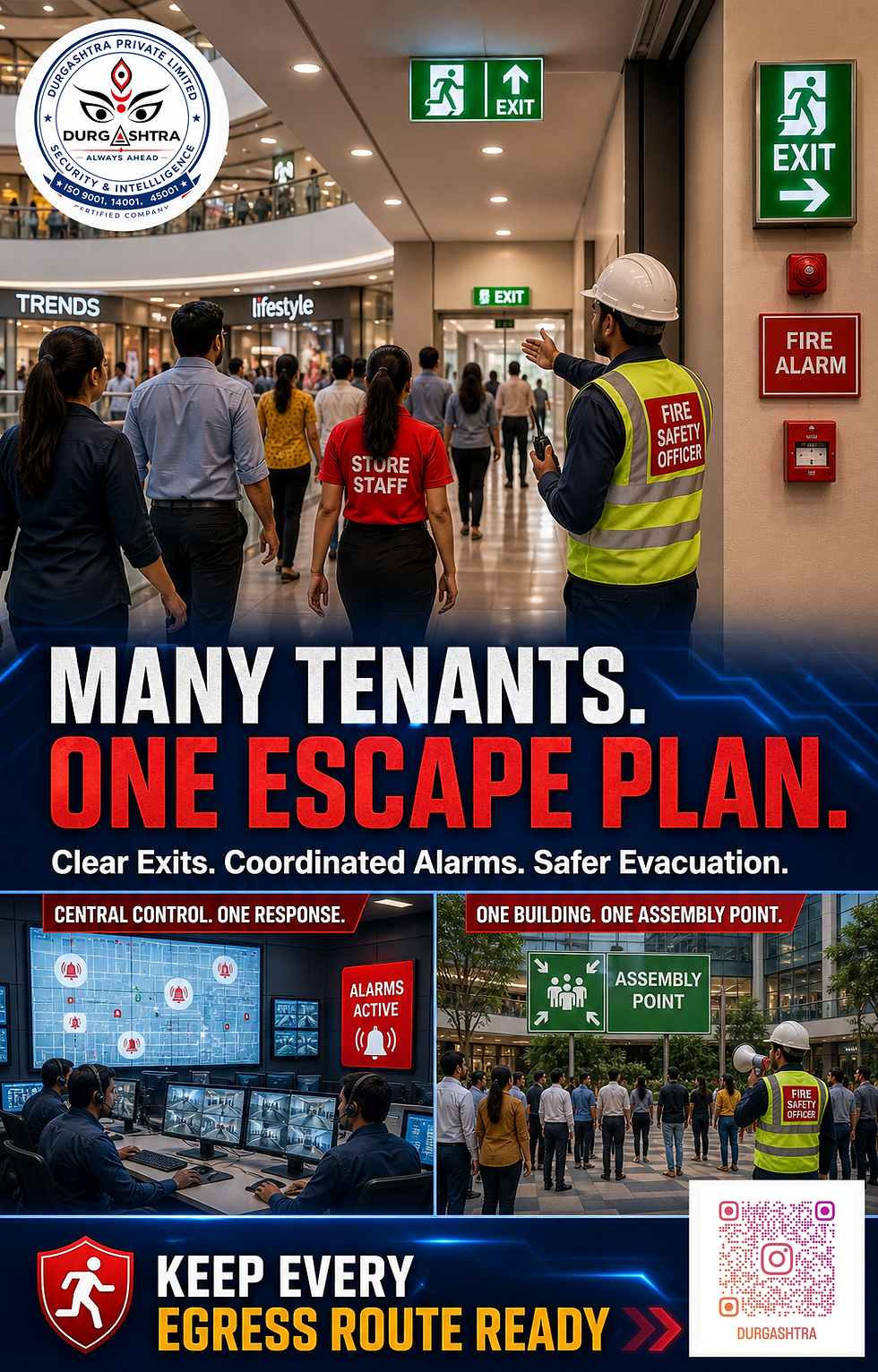
Aligned emergency and fire safety planning, since evacuation and crisis response genuinely can't be tenant-specific in a shared building, as covered in the related piece on multi-tenant fire safety.
Why landlords and management companies benefit from treating this as a designed relationship, not an assumed one. Property value and tenant retention both depend partly on a commercial property's security reputation — and that reputation is a property-wide outcome, not something any single tenant can protect or damage in isolation. A deliberately coordinated security relationship across landlord, management, and tenants protects that shared interest more effectively than each party managing their own piece independently.
Durgashtra works directly with property management companies and landlords to design property-wide security plans with clearly defined tenant coordination points, rather than treating multi-party commercial properties as a collection of separate, disconnected security relationships.
Durgashtra Private Limited designs coordinated, property-wide security arrangements for commercial and retail properties involving landlords, management companies, and multiple tenants.


Comments